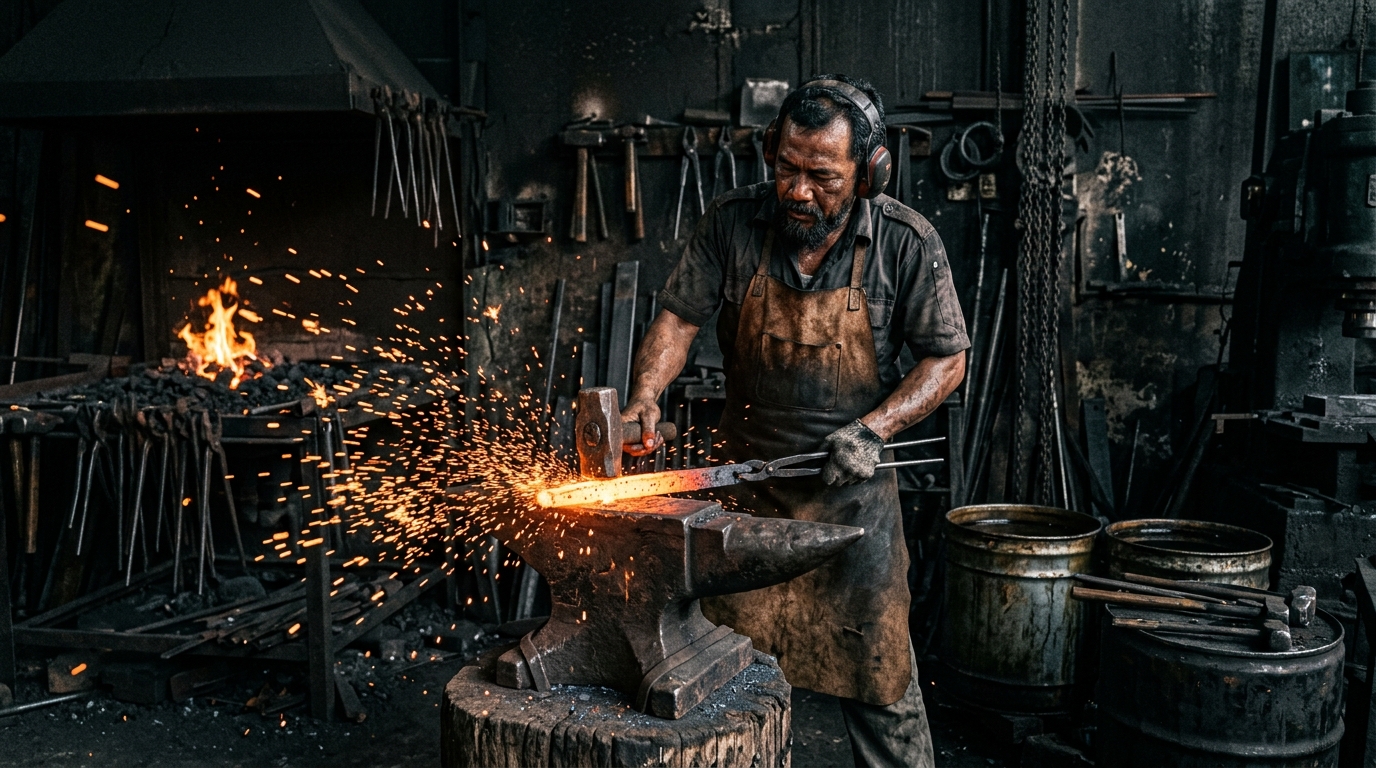
Every blade produced by CV. Artha Karya Presisi undergoes a rigorous 6-stage metallurgical cycle. In our Tegal facility, ancient Indonesian heirloom blacksmithing intersects with aerospace-grade vacuum thermal treatment.
Precision standards audited against international cutlery specifications.
Alternating sheets of 1095 high-carbon steel and 15N20 nickel alloy (or VG10 stainless laminate) are welded and heated to 1,200°C in an oxygen-controlled forge furnace.
The glowing billet is drawn out and folded repeatedly up to 67 or 128 layers. Artisans twist, cut, or press ladder dies to induce organic wave, raindrop, and feather patterns.
Blades are austenitized in high-vacuum furnaces to avoid surface decarburization, fast-quenched in agitated oil, and plunged into liquid nitrogen to maximize hardness to 60-62 HRC.
To prevent heat ruin of the crystal structure, bevel grinding is performed on continuous coolant belt grinders. Blade distal taper and convex bevels are shaped to sub-millimeter precision.
Edged by master sharpeners on water whetstones (up to 8,000 grit) followed by diamond-paste leather stropping. Achieves an effortless push-cut paper test score below 120 BESS.
Every production batch is tested on calibrated digital Rockwell C indenters. Blades undergo spine flex tests and spine-alignment optical verification before laser etching.
Compare the performance characteristics of our standard blade alloys for wholesale procurement and OEM private-label builds.
| Steel Grade | Typical HRC | Edge Retention | Toughness | Corrosion Resistance | Best Application |
|---|---|---|---|---|---|
| VG10 Damascus (67 Layers) | 60 - 62 HRC | ★★★★★ | ★★★★☆ | ★★★★★ (High Stainless) | High-End Chef & Kiritsuke Art Knives |
| 1095 / 15N20 Raindrop Damascus | 59 - 61 HRC | ★★★★☆ | ★★★★★ | ★★★☆☆ (Carbon Care) | Artisan Collector Bowie, Traditional Knives |
| Forged D2 High-Carbon Tool Steel | 59 - 61 HRC | ★★★★★ | ★★★★☆ | ★★★★☆ (Semi-Stainless) | Tactical Fixed Blades, Hard Bushcraft |
| 1095 Spring Carbon Steel | 57 - 59 HRC | ★★★☆☆ | ★★★★★ | ★★☆☆☆ (High Carbon) | Heavy Bone Cleavers, Machetes, Choppers |
| Böhler M390 Microclean (Custom OEM) | 61 - 63 HRC | ★★★★★ | ★★★★☆ | ★★★★★ (Ultra Stainless) | Premium Bespoke Tactical EDC Folding Knives |
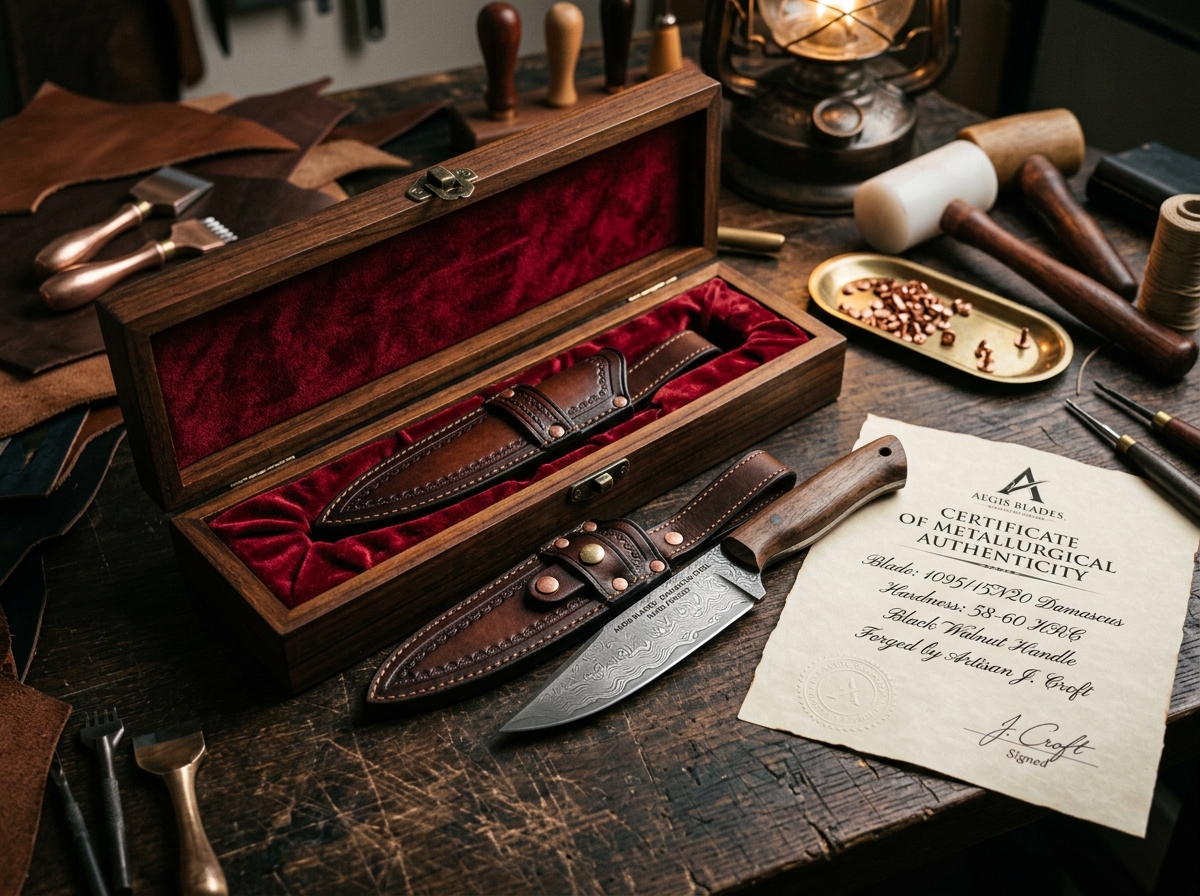
The balance of an exquisite blade depends on its handle ergonomics. We harvest responsibly sourced indigenous Indonesian hardwoods renowned for density, moisture resistance, and deep dimensional figure:
CV. Artha Karya Presisi
Your RFQ list is empty.
Add knife models from our catalog to receive a tailored wholesale quotation.